


The rumor that mascara contains bat poop is one of those persistent urban legends that has circulated in beauty circles for decades. If you have ever scrolled through social media or chatted with friends about makeup safety, you might have heard someone claim that your favorite lash-enhancing product is formulated with guano.
It sounds shocking, and for many, it is enough to make them check the label on their tube of mascara twice. However, the reality of cosmetic chemistry is far less exotic and much more regulated than these viral myths suggest.
The short answer is no, mascara does not have bat poop in it. This myth likely stems from a linguistic misunderstanding involving the word guanine, a common ingredient in many cosmetic products.
Because the name sounds remarkably similar to guano, the biological term for bat excrement, people have mistakenly conflated the two. In this article, we will break down exactly what is inside your makeup, how these ingredients are sourced, and why the beauty industry is held to such high standards that such a bizarre additive would be impossible to include.
The Linguistic Confusion: Guanine Versus Guano
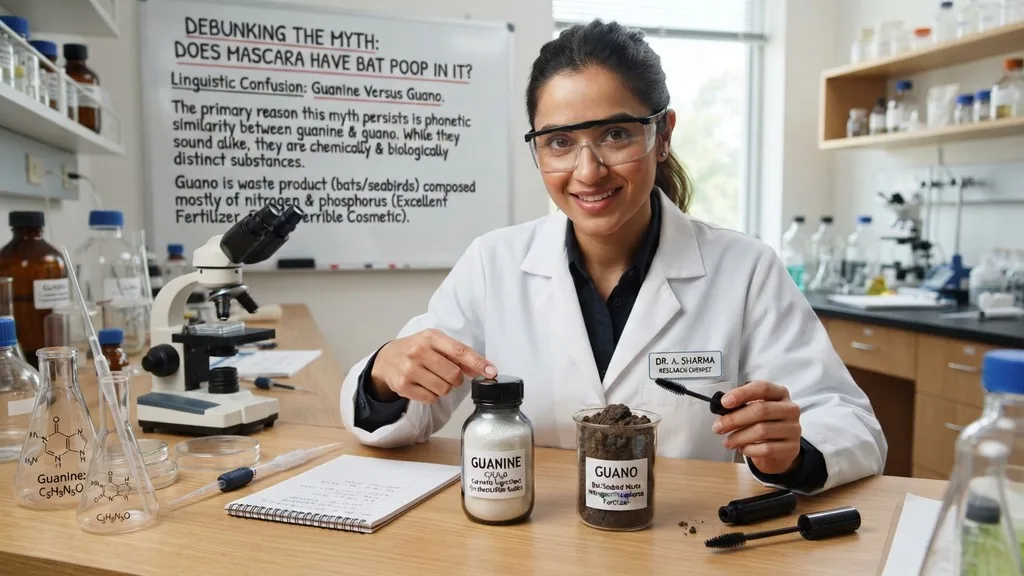
The primary reason this myth persists is the phonetic similarity between guanine and guano. While they sound alike, they are chemically and biologically distinct substances.
Guano is the waste product of bats and seabirds, composed mostly of nitrogen and phosphorus, which makes it an excellent fertilizer but a terrible cosmetic ingredient. Guanine, on the other hand, is a naturally occurring crystalline compound that plays a vital role in the biological structure of living organisms.
Guanine is one of the four main nucleobases found in DNA and RNA. In the context of beauty, it is used as a pearlescent pigment. It produces a shimmering, light-reflecting effect that gives cosmetics like mascara, eyeshadow, and nail polish their signature luster.
Historically, this substance was extracted from fish scales, specifically those of herring, which were processed to isolate the crystals. Today, while some high-end products still use natural sources, much of the guanine used in commercial makeup is synthetic or derived from other sustainable sources to ensure safety and ethical compliance.
Understanding the Ingredients in Mascara
When you look at the back of a mascara tube, you are looking at a complex mixture of pigments, oils, waxes, and polymers. Manufacturers design these formulas to perform specific tasks: lengthening, volumizing, curling, or thickening. To achieve these results, chemists select ingredients that are stable, non-toxic, and capable of adhering to the delicate hairs of your lashes without causing irritation or smudging.
Common components found in standard mascara include:
- Waxes: Ingredients like beeswax, carnauba wax, or candelilla wax provide structure and help the mascara coat each lash evenly.
- Oils: Mineral oil, castor oil, or plant-based oils keep the formula smooth and prevent it from drying out or flaking off during the day.
- Pigments: Iron oxides and carbon black are the industry standards for providing the deep, dark color we associate with high-quality mascara.
- Film-formers: Polymers and resins help the product adhere to the lashes and provide water resistance.
- Preservatives: These are essential to prevent the growth of bacteria and fungi, ensuring the product remains safe for use near the eye.
The Role of Pigments and Carbon Black
If you are concerned about what gives your mascara its intense black pigment, you can rest easy knowing it is not waste-based. The most common colorant used in the beauty industry is iron oxide, a naturally occurring mineral.
For that extra-deep, “inky” look, many brands incorporate carbon black. This is a finely divided form of amorphous carbon, produced by the controlled combustion of hydrocarbons.
Carbon black is incredibly effective because it provides high tinting strength and stability. It is a strictly controlled ingredient in the cosmetic world.
Regulatory bodies, such as the FDA in the United States and the European Commission, have strict guidelines regarding the purity and safety of carbon black used in eye makeup. The idea that a company would replace such a standard, cost-effective, and safe pigment with something as unpredictable and hazardous as animal waste is entirely inconsistent with how modern manufacturing works.
Regulatory Standards and Consumer Safety
The beauty industry is subject to rigorous oversight to ensure that products are safe for human use. Before any product reaches the shelf, it must undergo extensive testing to ensure it does not cause allergic reactions, eye irritation, or long-term health issues. The notion that a major cosmetic brand could include an ingredient like bat poop in their formulation is functionally impossible due to these safety protocols.
If a manufacturer were to include an unsanitary substance like guano, the product would fail microbial testing immediately. Mascara is applied in a very sensitive area—the eye—which is highly susceptible to infection. Because of this, mascara formulas are packed with effective preservative systems.
These preservatives are designed to kill bacteria and prevent contamination. Introducing biological waste into such a product would violate every health and safety regulation in existence, leading to immediate product recalls, massive lawsuits, and the permanent closure of the company. You can find more information about these safety guidelines through the official FDA cosmetics regulations portal.
Comparing Cosmetic Ingredients
To clear up the confusion regarding what is actually in your beauty routine, it helps to look at common ingredients that people often misidentify or worry about. Many consumers assume that if an ingredient sounds “chemical” or “strange,” it must be harmful or derived from animals. In reality, most ingredients are either synthetic equivalents of natural substances or highly purified minerals.
| Ingredient | Common Source | Purpose in Mascara |
|---|---|---|
| Guanine | Fish scales / Synthetic | Provides shimmer and luster |
| Iron Oxides | Mineral deposits | Provides black/brown pigment |
| Beeswax | Honeybees | Thickens the formula |
| Carbon Black | Hydrocarbon combustion | Intense black coloration |
Why Urban Legends About Makeup Persist
The “bat poop in mascara” myth is a classic example of how urban legends spread in the digital age. It taps into a primal fear—the idea that something we put on our bodies every day might be contaminated or gross.
When a rumor sounds shocking, it is more likely to be shared on social media, even if it lacks any factual basis. Once a myth gains traction, it becomes difficult to debunk, as the initial sensational claim is often more memorable than the boring, scientific truth.
Furthermore, the beauty industry has historically been shrouded in a bit of mystery. In the past, some ingredients were indeed sourced from animals, such as crushed beetles for red lipstick (carmine) or whale oil for various creams.
While many of these practices have been phased out due to ethical concerns and the rise of superior synthetic alternatives, the legacy of these ingredients makes people suspicious of what might be lurking in their makeup bags. This skepticism, while healthy in moderation, can sometimes lead to the spread of misinformation when not grounded in current facts.
Debunking Other Common Mascara Myths
Beyond the bat poop narrative, there are several other persistent myths about mascara that confuse consumers. One common belief is that mascara is made from “spider legs.” This is entirely false.
Mascara is a fluid, not a collection of insect parts. The texture is achieved through the emulsion of waxes and oils, not through the inclusion of organic animal appendages. If you were to look at a tube of mascara under a microscope, you would see a smooth, homogeneous mixture of particles suspended in a liquid base, not anything resembling insect anatomy.
Another myth is that mascara causes your eyelashes to fall out if you wear it every day. While it is true that mascara can cause breakage if you are rough with your removal process, the product itself is not designed to dissolve your hair.
If you use a gentle makeup remover and avoid pulling on your lashes, your natural growth cycle should remain completely unaffected. The fear surrounding these products is often a result of improper usage rather than the ingredients themselves.
Addressing Topical Gaps: What About Vegan Mascara?
A common question that arises when discussing cosmetic ingredients is whether products like mascara can ever be truly vegan. Since the myth of bat poop often stems from concerns about animal products, it is worth exploring how the industry handles animal-derived ingredients. Many people seek out vegan-certified beauty products because they want to ensure no animal by-products are used in their routine.
If you are concerned about animal-derived ingredients, look for the “vegan” label. This means the product does not contain beeswax, which is a common ingredient in non-vegan mascaras. Instead of beeswax, these formulas use plant-based waxes like carnauba or candelilla.
Regarding the guanine myth, vegan mascara brands specifically ensure that their pearlescent pigments are synthetic or mineral-based, completely avoiding any derivatives from fish scales. By opting for certified vegan products, you can completely sidestep any anxiety regarding the origin of your lash-enhancing ingredients.
The Importance of Checking Labels
If you are ever unsure about what is in a product, the most reliable source of information is the ingredient list on the packaging or the manufacturer’s official website. By law, cosmetic companies must list their ingredients in descending order of concentration. This transparency allows consumers to make informed decisions about what they are putting on their skin and near their eyes.
If you see an ingredient that you do not recognize, a quick search on a reputable cosmetic database can provide clarity. Most ingredients that sound scary are actually standard compounds used for preservation, texture, or pigment stability.
Understanding that the cosmetics industry is highly regulated and that “guano” and “guanine” are two completely different things should provide peace of mind. You can enjoy your beauty routine without the fear that your mascara contains anything other than carefully tested, cosmetic-grade components.
FAQ: Common Questions About Mascara Ingredients
- Is it true that mascara contains crushed insects? No. While some older cosmetic products used carmine (derived from cochineal beetles) for red pigments, it is not used to create the black pigment in mascara. Modern mascaras use synthetic or mineral-based pigments like iron oxides and carbon black.
- Why do people think there is bat poop in makeup? The myth is based on the confusion between “guanine,” a common pearlescent ingredient used to add shimmer to cosmetics, and “guano,” which is the scientific term for bat waste. They are completely unrelated substances with no shared chemical composition.
- Can mascara cause eye infections? Mascara itself does not cause infections, but improper hygiene can. Using expired products, sharing mascara with others, or failing to remove it before sleeping can introduce bacteria to the eye area. Always replace your mascara every three months to ensure the preservative system remains effective.
- Are there any animal products in mascara? Some mascaras contain beeswax, which is an animal by-product. If you prefer to avoid all animal-derived ingredients, you should look for brands that specifically label their products as “vegan,” as these will use plant-based waxes instead of beeswax.
In summary, the next time you hear someone ask, “does mascara have bat poop in it,” you can confidently explain the origin of the rumor. It is a classic case of a linguistic misunderstanding amplified by the internet.
Your mascara is a product of sophisticated chemistry, designed to be safe, effective, and free from the bizarre additives that urban legends suggest. By focusing on ingredient transparency and practicing good hygiene, you can continue to use your favorite lash products with complete confidence.


