


The rumor that your favorite tube of lash-lengthening product contains animal waste is one of the most persistent urban legends in the beauty industry. If you have ever wondered, does mascara have bat poop in it, you are certainly not alone.
This myth has circulated for decades, often whispered as a “fun fact” during sleepovers or shared in online forums as a cautionary tale about the bizarre origins of common household items. Despite the visceral reaction the idea of guano in makeup creates, the scientific reality is far less sensational, though it does involve a specific chemical compound that often gets confused with animal excrement due to a linguistic similarity.
The Linguistic Origin of the Bat Poop Myth
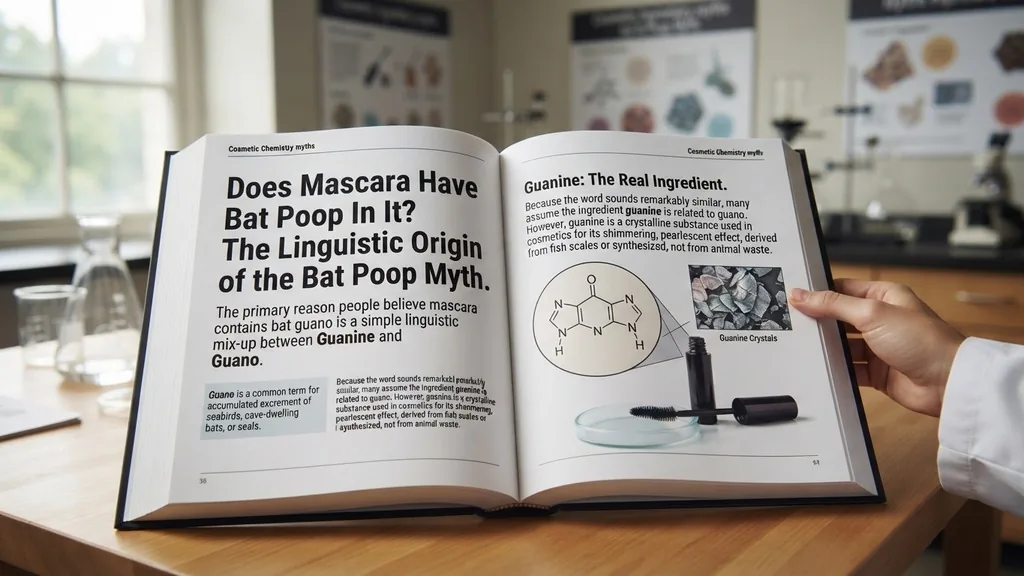
The primary reason people believe mascara contains bat guano is a simple linguistic mix-up between the words “guanine” and “guano.” Guano is the common term for the accumulated excrement of seabirds, cave-dwelling bats, and seals. Because the word sounds remarkably similar to guanine, a substance actually used in the cosmetic industry, the rumor gained traction.
It is a classic example of how a misheard term can evolve into a widespread urban legend. When consumers hear that their makeup contains “guanine,” they search for the definition, see the phonetic resemblance to “guano,” and leap to the conclusion that their beauty routine involves agricultural fertilizer.
In reality, guanine is a crystalline material that appears as shimmering, pearlescent particles. It is a naturally occurring nucleobase found in the DNA and RNA of all living organisms. While it can be sourced from fish scales, it is fundamentally different from the waste products produced by bats.
The confusion serves as a reminder of how easily scientific terminology can be misinterpreted when it enters the public consciousness. Manufacturers and chemists rarely use the term “guano” in product labeling, but because “guanine” is frequently listed in the ingredients section of many cosmetics, the myth persists as a misunderstanding of chemical nomenclature.
Understanding Guanine and Its Role in Cosmetics
Guanine serves a very specific purpose in beauty products: it provides a lustrous, iridescent, or pearlescent finish. If you have ever noticed that your mascara or eyeshadow has a subtle, shimmering quality that catches the light, you are likely looking at the effects of guanine.
This compound acts as a light-reflector, helping to create the “glow” or “sheen” that many consumers associate with high-quality, vibrant makeup. It is not an ingredient used for structural integrity or pigmentation, but rather for aesthetic appeal.
Historically, guanine was harvested from the scales of herring and other silvery fish. The scales are processed to extract the crystalline guanine, which is then purified for use in various beauty applications. Because it is a natural derivative, it is often marketed as a high-end alternative to synthetic pearlizing agents.
However, due to concerns regarding animal welfare and the high cost of harvesting natural scales, many modern companies have shifted toward synthetic alternatives. These synthetic versions provide the same light-reflecting properties without the need for biological extraction, further distancing the industry from any association with animal byproducts, let alone bat waste.
What Is Actually Inside Your Mascara?
When you look at the back of a mascara tube, you are looking at a complex chemical formulation designed to adhere to your lashes without smudging or flaking. The ingredients list is carefully regulated by organizations like the U.S. Food and Drug Administration to ensure that every component is safe for use around the delicate skin of the eyes.
Mascara is generally composed of three main elements: pigments, oils, and waxes. These work together to coat the hair shaft, providing color, thickness, and hold.
The pigments are responsible for the deep black or brown color of the product. The most common pigment used is carbon black or iron oxides. These provide the opaque saturation that defines the product.
The waxes, such as beeswax, carnauba wax, or paraffin, are used to thicken the formula and help it cling to the lash. Finally, oils and polymers are included to ensure that the mascara remains flexible and does not dry into a brittle, cracking mess. If you look closely at these ingredients, you will find no mention of animal feces, as the inclusion of such a substance would be biologically dangerous, legally prohibited, and chemically ineffective for the purposes of eye makeup.
Why Bat Poop Would Never Be Used in Makeup
Beyond the linguistic confusion, it is important to consider the practical aspects of cosmetic manufacturing. The beauty industry is governed by strict sanitary standards. The introduction of any biological waste, such as bat guano, would be a public health nightmare.
Guano is rich in bacteria, fungi, and potentially harmful pathogens that would cause severe eye infections, irritation, and allergic reactions. A mascara formula that included organic waste would be unstable, prone to rapid microbial growth, and impossible to preserve for shelf life.
Furthermore, the chemical composition of guano is entirely unsuited for makeup. It is essentially a mix of nitrogen-rich organic compounds and mineral salts. It does not possess the light-reflecting properties of guanine, the binding capabilities of waxes, or the pigment density of carbon black.
If a manufacturer were to somehow incorporate it, the result would be a foul-smelling, clumpy, and dangerous paste that would be rejected immediately by any quality control process. The myth ignores the reality that cosmetic chemists spend millions of dollars ensuring that formulas are sterile and stable.
The Truth About Fish Scales and Pearl Essence
While the bat poop theory is entirely false, the rumor about fish scales has a grain of truth. For many years, the cosmetic industry utilized “pearl essence,” which is essentially a suspension of guanine crystals derived from fish scales. This substance is what gives many nail polishes, eye shadows, and mascaras their characteristic shimmer.
It is a legitimate, albeit niche, ingredient. Because the scales are a byproduct of the fishing industry, many companies viewed this as a sustainable way to utilize parts of the fish that would otherwise be discarded.
However, the industry has evolved. Many modern consumers prefer vegan and cruelty-free options, which has led to a significant decrease in the use of fish-derived guanine. Today, most shimmering effects are achieved through synthetic mica or bismuth oxychloride.
These mineral-based alternatives are cleaner, more consistent, and entirely free of animal products. If you are concerned about whether your makeup contains animal derivatives, you can easily check the ingredient list for “guanine” or “pearl essence.” If these are not listed, your product is likely using synthetic minerals, which are common in almost all mass-market beauty brands today.
Identifying Common Mascara Ingredients
To demystify the product further, it helps to break down the common components found in a standard tube. Understanding these ingredients helps you realize that the chemistry of beauty is a precise science, not a collection of random animal waste products.
- Carbon Black / Iron Oxides: These are the primary pigments that give mascara its deep color.
- Beeswax / Carnauba Wax: These natural waxes provide the structure that allows the product to build volume on your lashes.
- Polymers: These help the mascara adhere to the lash and prevent it from running or smudging throughout the day.
- Preservatives: Ingredients like phenoxyethanol or parabens are essential to prevent the growth of bacteria and mold within the tube.
- Oils: Mineral oil or various plant-based oils (like castor oil) are used to keep the formula smooth and prevent it from drying out too quickly.
By viewing the ingredients through this lens, you can see that each item has a specific function. There is no room in this carefully balanced formula for extraneous biological matter. Every addition is tested for compatibility and safety, ensuring that the final product is safe to apply near the eyes.
Comparing Traditional vs. Modern Formulations
The evolution of makeup technology has moved away from biological materials toward more stable, lab-created ingredients. This transition has made cosmetics safer and more consistent for the average consumer. The following table highlights the differences between older, traditional ingredients and modern synthetic alternatives.
| Ingredient Type | Traditional Source | Modern Alternative |
|---|---|---|
| Shimmer/Pearlescence | Fish Scales (Guanine) | Synthetic Mica / Bismuth Oxychloride |
| Pigment | Natural Ores / Charcoal | Iron Oxides / Synthetic Carbon Black |
| Wax Base | Animal Fats | Plant-based Waxes (Carnauba / Candelilla) |
| Preservation | Essential Oils | Chemical Preservatives (Parabens / Phenoxyethanol) |
This comparison illustrates that the beauty industry has moved toward standardization. The use of synthetic alternatives ensures that your makeup is not only free from animal byproducts but also free from the natural variations and contamination risks associated with biological materials.
Addressing Other Common Beauty Myths
The “bat poop” myth is just one of many urban legends that plague the beauty industry. Because makeup is something we apply directly to our bodies, people are naturally skeptical and curious about its origins. Other common myths include the idea that mascara is made of “crushed spider legs” or that lipsticks contain “beetle blood.”
These myths usually stem from a lack of understanding about how color is produced. For example, carmine, a red pigment, is indeed derived from the cochineal insect. While this is a real animal derivative, it is highly processed and purified, and it bears little resemblance to the “beetle blood” or “bug guts” often described in sensationalist articles.
When you encounter these stories, it is helpful to look for the scientific name of the ingredient. If you see “CI 75470” on a label, you are looking at carmine. By searching for the Color Index (CI) number, you can find exactly what an ingredient is and how it is sourced.
This level of transparency is required by law in most countries, meaning that manufacturers cannot hide ingredients. If an ingredient is not listed on the label, it is not in the product. The fear surrounding these products is almost always based on a misunderstanding of the actual scientific components involved.
Frequently Asked Questions
- Is it true that mascara contains guanine from bats? No, that is a myth. Guanine is a crystalline substance used for pearlescence. While it sounds like “guano” (bat poop), they are completely different. Guanine is derived from fish scales or created synthetically; it has no connection to bat excrement or any animal waste.
- Are there any animal products in my mascara? Some mascaras use beeswax or carmine (a pigment derived from insects). However, the vast majority of mainstream brands use synthetic waxes and pigments. If you are looking for vegan-certified products, check the packaging for a “vegan” or “cruelty-free” label to ensure no animal derivatives are present.
- Can mascara cause eye infections if it’s old? Yes, but not because of its ingredients. Mascara is a breeding ground for bacteria because of the dark, moist environment of the tube. You should replace your mascara every three months to prevent the buildup of harmful bacteria that could lead to conjunctivitis or other eye irritations.
- What should I do if I’m worried about my makeup ingredients? The best approach is to read the ingredient list on the back of the packaging. You can look up any unfamiliar chemical names on reputable cosmetic safety databases. If a product does not list its ingredients, it is best to avoid it entirely to ensure your safety.
In summary, the rumor that mascara contains bat poop is entirely unfounded. It is a classic case of phonetic confusion between guanine and guano. Modern cosmetics are highly regulated, scientifically tested, and carefully formulated to ensure safety and performance.
By understanding the actual ingredients—such as iron oxides, waxes, and synthetic shimmer agents—you can feel confident in the products you use every day. Focus on quality, check your labels, and rest assured that your beauty routine is free from any unwanted biological surprises.


