

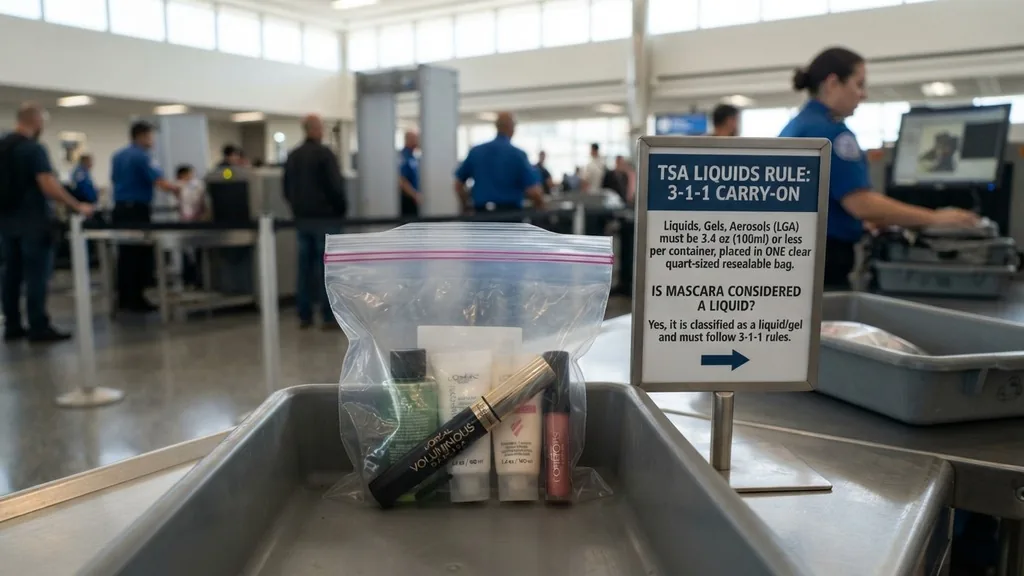
When you head to the airport, the confusion surrounding what qualifies as a prohibited substance in your carry-on is common. Many travelers ask, is mascara considered a liquid, especially when they are trying to pack their toiletry kits efficiently. The short answer is yes: the Transportation Security Administration (TSA) categorizes mascara as a liquid, gel, or aerosol.
Because of its viscosity and chemical consistency, it falls under the same strict security protocols as your shampoo, perfume, or liquid foundation. Understanding these rules is essential if you want to avoid having your favorite beauty products tossed into the trash at the security checkpoint.
The TSA Classification of Cosmetics

Is mascara considered a liquid by the TSA? Yes, the TSA classifies mascara as a liquid because of its semi-fluid state.
According to their official guidelines, any substance that can be poured, pumped, squeezed, spread, smeared, or sprayed is subject to the 3-1-1 liquids rule. Since mascara is a viscous substance that fills the volume of its container and can be squeezed out, it is treated exactly like a liquid.
When you bring makeup through a security checkpoint, the agents are not looking for the chemical definition of a liquid; they are looking for substances that could potentially mask prohibited items or create security risks. Because mascara has a high moisture content and is stored in a tube, it is categorized alongside other creams and pastes.
If you are preparing for a flight, you must treat your mascara as part of your total allowance for carry-on liquids. Failure to account for this can lead to delays during the screening process, or worse, the loss of a high-end product.
The 3-1-1 Rule for Your Carry-On
To successfully travel with your beauty routine, you must comply with the 3-1-1 liquids rule. This rule states that each passenger is allowed to bring liquids, gels, and aerosols in their carry-on bag, provided they are in containers of 3.4 ounces (100 milliliters) or less. All of these items must fit into a single, clear, quart-sized, zip-top plastic bag.
Because mascara tubes are almost always under 3.4 ounces, they easily satisfy the volume requirement. The challenge lies in the bag capacity. If you have an extensive collection of items like concealer, foundation, lip gloss, and mascara, they must all fit comfortably inside that single quart-sized bag.
If your bag is bulging or cannot zip closed, you might be asked to remove items or move them to your checked luggage. You can find more specific information on the official TSA What Can I Bring page to ensure your travel preparations are fully compliant.
Why Mascara is Treated as a Liquid
Why does a thick, waxy substance like mascara fall under the same category as water? The answer lies in the physical properties of the product.
Most mascaras are emulsions, meaning they contain a mixture of water, waxes, and pigments. While they are not as free-flowing as water, they are technically classified as pastes or gels.
Security screening technology relies on the density and chemical composition of the items in your bag. A tube of mascara, while small, contains enough volume to be scrutinized by X-ray machines. Because it is a semi-solid material, it is grouped with other substances that display similar properties.
When items are in their containers, the consistency is what determines the classification. Even if your mascara is quite dry or “clumpy,” it is still officially recognized as a liquid or gel by security personnel. It is always safer to assume it is a liquid and pack it accordingly to avoid any issues at the checkpoint.
Packing Strategies for Frequent Flyers
If you are a frequent traveler, you know that the space inside a quart-sized bag is limited. Knowing that is mascara considered a liquid, you should prioritize which products you actually need in your carry-on versus those that can go in your checked bags.
- Consolidate your liquid makeup into one TSA-compliant bag before arriving at the airport.
- Use travel-sized versions of your foundation or moisturizer to save space for your mascara and eyeliner.
- Consider using solid makeup alternatives like powder foundation or stick blush, which are not subject to the same strict liquid volume restrictions.
- Keep your liquids bag at the top of your carry-on for easy access during the screening process.
- Check your mascara for leaks; the air pressure changes in the cabin can sometimes cause tubes to seep, which creates a mess inside your bag.
By organizing your toiletries ahead of time, you minimize the stress of the screening process. Many travelers find that switching to a clear, durable toiletry bag makes it easier to keep their items sorted and visible, which helps security officers process your bag more quickly.
Comparison of Common Makeup Consistency
To understand why some items pass through security with ease while others require the 3-1-1 treatment, it helps to look at the physical state of common beauty products. The following table provides a breakdown of how different makeup types are generally classified by security protocols.
| Product Category | TSA Classification | Packing Requirement |
|---|---|---|
| Mascara | Liquid/Gel | Must fit in quart-sized bag |
| Powder Eyeshadow | Solid | No volume restriction |
| Liquid Foundation | Liquid | Must fit in quart-sized bag |
| Lipstick | Solid | No volume restriction |
| Cream Blush | Gel/Paste | Must fit in quart-sized bag |
As you can see, the distinction often comes down to whether the product is a solid or a fluid. If you can smudge it, squeeze it, or pour it, it is best to pack it in your liquids bag. This keeps your travel experience smooth and prevents your favorite makeup from being confiscated.
Exceptions and Special Circumstances
Are there ever exceptions to the rule? Generally, no. Regardless of the brand or the price of your mascara, the rules apply universally.
However, there are some nuances regarding medical liquids or items required for specific physical needs. If you have a medical necessity for a specific type of makeup, you might be granted an exception, but this typically requires prior notification and additional screening.
For the average traveler, the rules are rigid. Do not assume that because an item is expensive or sealed in original packaging that it is exempt from the 3-1-1 rule. Security agents are trained to look for the physical state of the substance, not the marketing label.
If you are traveling internationally, remember that other countries may have even stricter regulations than the TSA. Always check the airport security website for your destination, as they might define liquids differently or have different size limitations for carry-on items.
Common Mistakes When Packing Makeup
Many travelers make the mistake of assuming that small items don’t count toward their liquid limit. A common error is keeping mascara tubes scattered throughout various pockets of a carry-on bag. When security agents see items that look like liquids or gels in random locations, they may have to pull your bag aside for a manual search.
Another mistake is using bags that are not truly quart-sized. If you use a bag that is too large, you are technically not in compliance. If you use a bag that isn’t clear, agents cannot easily verify the contents, which leads to delays.
Always use a standard, clear, quart-sized bag to keep your items visible. This transparency is the key to a fast and efficient security experience. Furthermore, avoid packing your mascara in a bag that is already full of other liquids, as the pressure of the bag can cause the tube to crack or leak, ruining your other items.
Addressing the Topical Gaps
There is often confusion about whether “dry” mascara counts. Some users wonder if a mascara that is nearing the end of its life and has a thicker consistency is still a liquid. The technical answer is yes.
Even if the product has dried out significantly, it is still a substance that was originally processed as a liquid or gel. Security agents do not test the moisture content of your makeup on the spot.
Another gap in common knowledge is the difference between domestic and international travel regarding makeup. While the 3.4-ounce rule is standard in many parts of the world, some international airports have different standards for the size of the plastic bag or the number of bags allowed. Always check the specific requirements for your airline and destination.
When you pack makeup, think about the total volume of all your liquids combined. Even if each item is tiny, the aggregate volume must be manageable within the constraints of the security regulations.
FAQ Section
- Do I have to put my mascara in a plastic bag? Yes, you are required to place your mascara in a clear, quart-sized, zip-top bag along with your other liquids, gels, and aerosols to comply with the standard 3-1-1 TSA security regulations for carry-on luggage.
- Does mascara count as a liquid when I fly internationally? Yes, most international aviation authorities follow the same liquid restrictions as the TSA. Mascara is consistently classified as a liquid or gel in international airport security, regardless of the brand or the specific country you are departing from.
- What happens if I forget to put my mascara in my liquids bag? If you forget, it may be discovered during the X-ray screening process. You might be asked to remove it from your bag, or in some cases, the security officer may require a manual inspection of your carry-on, which can delay you.
- Is waterproof mascara treated differently than regular mascara? No, both waterproof and regular mascara are treated as liquids or gels by security personnel. The chemical formulation differences do not change the classification for the purpose of airport security screening, as both are semi-fluid substances contained in tubes.


