

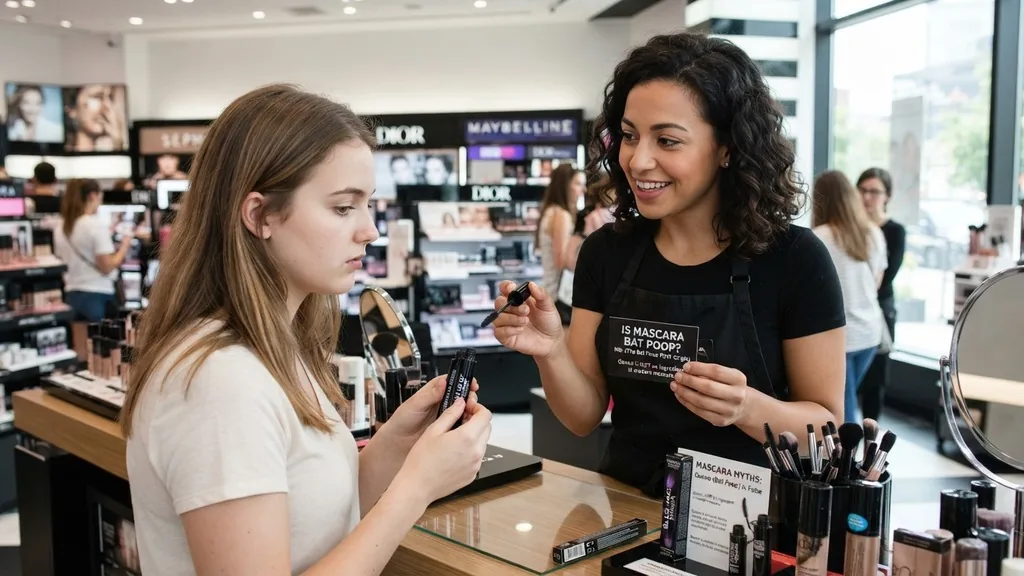
The persistent rumor that mascara is made of bat poop is one of the most enduring urban legends in the beauty industry. You have likely heard someone whisper at a sleepover or read on an internet forum that your favorite cosmetic product relies on guano to achieve its dark, volumizing effect. It sounds shocking, a little gross, and just strange enough to be believable in the context of historical beauty practices.
However, the reality is far less scandalous and significantly more scientific. Modern makeup manufacturers prioritize safety, stability, and performance, none of which are achieved by including waste products from flying mammals in your lash-enhancing formulas.
The Origin of the Bat Poop Myth

The belief that mascara is made of bat poop likely stems from a misunderstanding of a specific chemical compound called guanine. When people hear the word “guanine,” it sounds phonetically similar to “guano,” which is the common term for bat excrement. This linguistic confusion has fueled the myth for decades.
In reality, guanine is a crystalline substance that is found in various biological organisms, including fish scales. It is prized in the cosmetics industry for its ability to create a pearlescent or shimmering effect, but it has absolutely nothing to do with the waste of bats.
The confusion is compounded by the fact that historical beauty rituals often involved strange or even dangerous ingredients. From lead-based powders to arsenic-infused skin creams, the history of cosmetics is filled with questionable choices. Because the public is aware of this odd history, it becomes easy to accept the idea that “poop mascara” might have been a thing at some point.
However, no major cosmetic brand has ever used bat guano as an ingredient. The manufacturing process for beauty products is strictly regulated, and the inclusion of biological waste would violate basic safety standards, not to mention the practical impossibility of creating a stable, usable formula from such a substance.
What Actually Goes Into Your Mascara
When you look at the ingredient list on your favorite tube of makeup, you are seeing a carefully engineered cocktail of synthetic and natural compounds. These ingredients are chosen to ensure the product stays on your lashes, resists smudging, and provides the desired color payoff without irritating your eyes.
A typical formula is an emulsion, meaning it is a mixture of water and oils, held together by emulsifiers. The primary components usually include pigments, polymers, waxes, and preservatives.
The dark, rich color that defines most mascaras is typically provided by carbon black or iron oxides. These pigments are finely milled to ensure a smooth application that coats each lash from root to tip. Waxes, such as beeswax, carnauba wax, or paraffin, are responsible for the structure of the product.
They allow the formula to glide onto the lashes and then “set” or harden, giving your lashes that lifted, volumized look. Without these specific ingredients, your mascara would either be too runny to stay in place or too dry to apply effectively.
The Role of Guanine in Cosmetics
Since the confusion between guanine and guano is the primary driver of this myth, it is important to understand exactly what guanine does in the beauty world. Guanine is a nitrogenous base that occurs naturally in DNA and RNA, but in the context of cosmetics, it is extracted primarily from the scales of fish. It is a crystalline material that reflects light, which is why it is often used in products that require a shimmer or a glow, such as eyeshadows, highlighters, and some specialized mascaras.
It is helpful to view the relationship between these terms clearly:
- Guanine: A crystalline substance derived from fish scales used for shimmer.
- Guano: The excrement of bats or seabirds, which is used as fertilizer.
- Myth: The false claim that mascara contains bat waste due to the phonetic similarity between the two words.
Because guanine is a common ingredient, many people mistakenly assume that any product containing it must be “dirty” or “animal-based” in a way that implies waste. In reality, the cosmetic grade of guanine is highly purified and processed to ensure it meets rigorous safety standards. It is a far cry from the raw, unprocessed materials that people imagine when they hear the word “bat poop.”
Why Bat Guano is Not Used in Beauty Products
Beyond the fact that it sounds unappealing, there are insurmountable logistical and safety reasons why bat guano is not used in makeup. First and foremost, cosmetic manufacturers require consistency. Every batch of mascara must perform exactly the same way to satisfy consumer expectations and regulatory bodies.
Guano is a biological waste product that varies wildly in composition depending on the bat’s diet, the environment, and the age of the deposit. It would be impossible to standardize such a material for use in a delicate area like the eye.
Furthermore, the eye is one of the most sensitive organs in the human body. Introducing a substance like bat feces would pose a massive risk of bacterial infection, inflammation, and potential vision damage. The U.S.
Food and Drug Administration (FDA) and other international regulatory bodies maintain strict oversight on cosmetic ingredients to prevent exactly this kind of contamination. Any company attempting to use such an ingredient would be immediately shut down, face massive lawsuits, and lose all consumer trust. The industry relies on highly refined, lab-tested chemicals to ensure that your beauty routine remains safe.
Comparing Common Ingredients and Their Functions
To better understand what is really in your makeup, it is useful to look at how different substances function within a mascara formula. The following table highlights the roles of common ingredients found in most commercial lash products.
| Ingredient Category | Common Example | Primary Function |
|---|---|---|
| Pigments | Iron Oxides | Provides the dark, opaque color. |
| Waxes | Carnauba Wax | Adds volume and structure to lashes. |
| Polymers | Acrylates Copolymer | Helps the mascara adhere and resist smudging. |
| Oils | Mineral Oil | Keeps the formula smooth and prevents clumping. |
| Preservatives | Phenoxyethanol | Prevents microbial growth in the tube. |
As this table shows, every ingredient serves a specific, documented purpose. There is no room in this chemical architecture for organic waste products.
Each component is chosen for its specific melting point, viscosity, and color-binding properties. When you apply your mascara, you are utilizing a product that has undergone extensive stability testing to ensure it doesn’t degrade over time or cause adverse reactions.
The History of Mascara Evolution
The evolution of mascara is a fascinating look at how human ingenuity has sought to enhance beauty throughout the centuries. Ancient Egyptians used kohl, a mixture of soot, galena, and other minerals, to darken their eyes and protect them from the harsh desert sun. This was a primitive form of makeup that relied on natural earth pigments.
As the centuries passed, the formulas became more sophisticated. In the Victorian era, women used a mixture of coal dust and petroleum jelly to achieve a dark, dramatic lash look, which was the direct ancestor of modern mascara.
It wasn’t until the early 20th century, specifically with the invention of the famous “Maybelline” cake mascara, that the product became truly accessible to the masses. This early version was a cake of solidified soap and wax that had to be mixed with water and applied with a small brush.
It was messy, but it was the first real step toward the mascara we know today. The shift from these primitive, often homemade concoctions to the high-tech, waterproof, and fiber-infused formulas we have today is a testament to the growth of cosmetic chemistry, not the use of unusual animal products.
Addressing Topical Gaps: Why Misinformation Persists
One might wonder why the myth that mascara is made of bat poop remains so prevalent despite the clear evidence to the contrary. The answer lies in the nature of “gross-out” trivia. Humans are naturally drawn to shocking information, especially regarding the products we use on our bodies.
When a rumor sounds like a “dirty secret” of a massive industry, it spreads quickly on social media and through word-of-mouth. It taps into a distrust of large corporations, suggesting that they might be cutting corners or using cheap, disgusting ingredients to save money.
Additionally, the complexity of modern ingredient lists makes it difficult for the average consumer to verify the truth. When you see a long list of chemicals with names that are hard to pronounce, it is easy to assume that one of them might be a hidden, unpleasant substance. Education is the only way to combat this.
By understanding that “guanine” is not “guano” and that the cosmetic industry is subject to rigorous safety standards, consumers can feel more confident about the products they choose to apply to their faces. The persistence of the myth is a social phenomenon, not a reflection of the actual makeup manufacturing process.
How to Read Your Mascara Label
If you are ever concerned about what is in your beauty products, the best approach is to learn how to read the ingredient label. While the names can be intimidating, most labels follow a standard format. The ingredients are listed in descending order of concentration.
This means the first few ingredients make up the bulk of the formula, while the last few are typically preservatives or fragrances added in very small amounts. If you are looking for specific animal-derived ingredients, you can scan for terms like “beeswax” or “lanolin,” which are common in many mascaras but are strictly derived from bees and sheep wool, respectively.
If you are a vegan or prefer to avoid animal-derived ingredients entirely, many brands now offer “vegan mascara” that replaces beeswax with plant-based waxes like candelilla or rice bran wax. These products are clearly labeled and provide the same volumizing and lengthening benefits without using any animal products at all.
By taking the time to understand these labels, you can make informed choices that align with your values and ensure you are never surprised by the composition of your makeup. Transparency in the beauty industry has improved significantly, and most reputable brands are happy to disclose their full ingredient lists on their websites.
FAQ: Common Questions About Mascara
- Does mascara contain any animal waste products? No, mascara does not contain any animal waste or bat guano. Modern cosmetic regulations prohibit the use of such materials, and they would not provide any functional benefit to the formula.
- Is guanine the same thing as bat poop? No, guanine and guano are completely different. Guanine is a crystalline substance used for shimmer in cosmetics, typically derived from fish scales, while guano is the excrement of bats or birds.
- Why are people so convinced that mascara is made of bat poop? The myth persists due to the phonetic similarity between “guanine” and “guano.” This linguistic confusion, combined with a general curiosity about the hidden ingredients in beauty products, helps keep the urban legend alive.
- Are there any dangerous ingredients in mascara I should worry about? While mascara is generally safe, some individuals may have allergies to specific preservatives or dyes. Always check the ingredient list if you have sensitive skin, and consult a dermatologist if you experience persistent irritation.
The journey from the ancient use of kohl to the advanced formulas of today is one of progress and safety. While the idea that mascara might be made of bat poop makes for a memorable story, it is entirely devoid of truth. Understanding the actual science behind your beauty products—how pigments, waxes, and polymers work together—allows you to appreciate the complexity of the makeup you use every day.
You can rest assured that your lashes are being enhanced by carefully crafted chemistry, not by the waste of flying mammals. Stay curious, read your labels, and enjoy your beauty routine with the confidence that comes from knowing the facts.


