

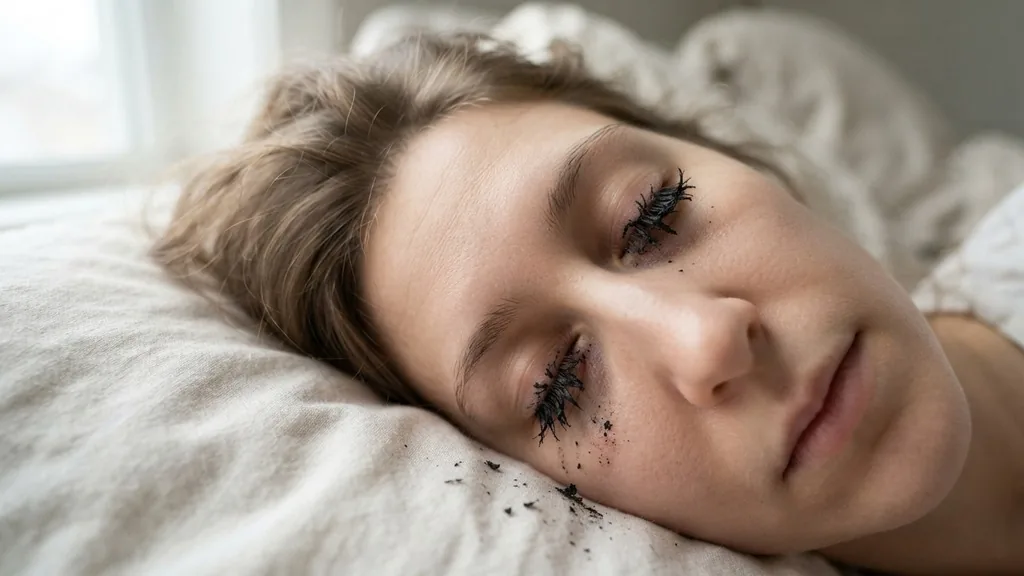
Falling into bed after a long day often makes the simple act of washing your face feel like an impossible chore. When you skip your nighttime routine and leave your eye makeup on, you aren’t just dealing with a messy pillowcase the next morning.
You are subjecting your delicate eyelid skin and sensitive eyes to a range of potential issues. Understanding what happens if you sleep with mascara on involves looking at both the physical texture of the dried product and the chemical composition of the ingredients sitting against your lash line for eight hours or more.
The Physical Impact on Your Eyelashes

Sleeping with mascara on primarily threatens the structural integrity of your lashes, often leading to increased brittleness and breakage. Mascara is formulated to coat and stiffen individual hairs to create volume and length. Once these products dry, they become rigid.
When you toss and turn against your pillow, that friction puts mechanical stress on your lashes. Because the hairs are held in a fixed, stiff position by the dried pigment, they are significantly less flexible than they would be if they were clean.
This lack of flexibility means that instead of bending when they brush against a pillowcase, your lashes are more likely to snap. Over time, this daily cycle of coating, drying, and crushing causes your eyelashes to become sparse. You might notice that your lashes look shorter or appear to be thinning.
Constant exposure to these hardening agents prevents the lashes from going through their natural, healthy cycle of movement. Furthermore, the weight and stiffness of the dried product can pull on the lash follicle, which is the most delicate part of the hair growth process. Consistently failing to remove your makeup can lead to a condition where you notice fewer lashes along the lid, as the hair is literally being snapped off at the base or pulled out prematurely.
Ocular Irritation and Bacterial Growth
The area around your eyes is incredibly sensitive, and introducing foreign substances for an extended period creates a breeding ground for discomfort. When you leave eye makeup on, you are essentially trapping debris, pollutants, and bacteria against the surface of the eye. Mascara is a moist environment when it is in the tube, and once applied, it can continue to harbor microorganisms if not cleaned off properly.
Sleeping with this product on can lead to redness, itching, and a gritty sensation known as ocular irritation. The tiny particles of makeup can flake off during the night and migrate into the eye itself. Once inside, these pigments act as physical abrasives against the cornea.
This often leads to the development of conjunctivitis or other forms of eye inflammation. If you wake up with eyes that feel “heavy” or “crusty,” it is often a direct result of the product migrating into the tear film. Your eyes rely on a clean environment to produce healthy tears, and when the meibomian glands—which provide the oils for your tears—become blocked by makeup residue, the result is often severe dryness and stinging that can persist throughout the entire following day.
Long-Term Effects on Skin Health
The skin around your eyes is the thinnest on your entire body, making it exceptionally prone to damage from improper hygiene. When you sleep with mascara on, you are often leaving other facial makeup on as well, which clogs pores and prevents the skin from undergoing its essential overnight renewal cycle. While mascara is focused on the lashes, the transfer of product onto the surrounding skin can cause contact dermatitis.
This condition manifests as red, scaly, or swollen patches of skin that are tender to the touch. Because the eyelid skin is so thin, it absorbs chemical ingredients from cosmetic products more readily than other parts of your face. Repeated exposure to preservatives, waxes, and pigments meant for hair can trigger an allergic reaction, even if you have used the same product for years without issue.
The accumulation of makeup also prevents your skin from “breathing,” which is a colloquial way of saying that the natural exfoliation process is hindered. When dead skin cells and makeup residue sit in the pores, it can lead to small bumps or milia, which are tiny, hard cysts that are notoriously difficult to remove without professional help.
The Importance of Removing Makeup Before Bed
Establishing a consistent routine to remove your makeup is the most effective way to prevent the damage associated with sleeping in cosmetics. Your skin and eyes perform a significant amount of repair work while you are asleep. By leaving a barrier of synthetic materials, waxes, and pigments on your face, you interfere with this natural restorative process.
To effectively cleanse, you should use a gentle, oil-based or micellar cleanser designed specifically for the eye area. These products are formulated to break down the water-resistant polymers found in most mascaras without requiring you to scrub or pull at your lashes. Rubbing the eyes is one of the most common causes of premature fine lines and wrinkles.
By using a soft cotton pad soaked in a cleanser, you can hold it against the lid for a few seconds to let the product dissolve the mascara, allowing you to wipe it away in a single, fluid motion. This method protects the lash follicles and ensures that no residue is left behind to irritate the eyes or clog the pores overnight. For a better understanding of how these habits affect your long-term vision, you can read more at the American Academy of Ophthalmology regarding safe cosmetic practices.
Comparing Consequences of Neglect
It is helpful to categorize the risks based on the duration of the neglect and the specific area being affected. Not all instances of sleeping in makeup result in immediate disaster, but the cumulative effect is what truly causes long-term harm to your beauty and health.
| Area of Impact | Short-Term Result | Long-Term Consequence |
|---|---|---|
| Eyelashes | Stiffness and potential breakage | Permanent thinning and lash loss |
| Eyes | Gritty feeling and redness | Chronic dry eye or infection |
| Eyelid Skin | Puffiness and minor irritation | Premature wrinkles and dermatitis |
As shown in the table above, the progression from minor discomfort to chronic issues happens when the habit becomes recurring. While one night of sleeping with mascara on might only result in a bit of morning smudging, doing it every night accelerates the aging process of the skin and weakens the physical structure of your lashes.
Common Topical Gaps: Myths vs. Facts
There is a significant amount of misinformation circulating regarding the safety of leaving makeup on overnight. Many people believe that “natural” or “organic” mascaras are safe to sleep in, but this is a dangerous misconception. Any product that is formulated to coat and stiffen a hair follicle is not meant to be left on while your face is pressed against a pillow.
Another common myth is that “waterproof” mascara is somehow cleaner because it doesn’t run. In reality, waterproof formulas are often the hardest to remove and require more aggressive friction to clear away, which can cause even more damage to the lashes if you are tired and rushing through your routine. You might also wonder if sleeping on your back prevents the damage.
While it may reduce the amount of direct friction against your lashes, it does nothing to address the chemical irritation caused by the product being in direct contact with your eyelid skin and the ocular surface for eight hours. The bottom line is that there is no “safe” way to sleep with mascara on; the best practice is always to prioritize a clean face before you head to bed.
What To Do If You Accidentally Sleep in Mascara
If you wake up and realize you forgot to take off your makeup, don’t panic, but do act immediately. The first step is to gently cleanse the area to remove all traces of the product.
Use a lukewarm, damp cloth to soften any dried mascara that has become clumped on your lashes. Never try to pick or pull at the dried mascara, as this will almost certainly take your natural lashes with it.
Once you have removed the makeup, apply a soothing, fragrance-free moisturizer to your eyelid area to counteract any potential dryness or inflammation. If your eyes feel particularly gritty or dry, a drop of preservative-free artificial tears can help flush out any micro-particles of makeup that may have migrated into your eye during the night. Avoid applying any new eye makeup for the rest of the day if your eyes feel sensitive or look red.
Give your eyes and the skin around them a “makeup-free day” to recover. This allows the meibomian glands to clear out and the skin to restore its natural moisture barrier without the interference of additional cosmetic products.
Developing a Foolproof Nighttime Routine
If you find yourself frequently skipping your makeup removal, the issue is likely a lack of convenience rather than a lack of knowledge. You can make the process nearly effortless by strategically placing your supplies. If you often fall asleep in the living room, keep a pack of high-quality, gentle makeup remover wipes on your coffee table.
* Keep a micellar water and a stack of reusable cotton rounds on your bedside table.
* Use a dual-phase eye makeup remover that is specifically designed for waterproof formulas.
* Prioritize cleansing before you start your favorite show or settle into bed.
* Consider using an eyelash conditioner or serum in the mornings to help strengthen lashes that have been previously weakened by neglect.
By integrating these small, low-friction habits, you remove the barriers that prevent you from taking care of your skin. A consistent routine is the best defense against the negative effects of sleeping in mascara.
It is not about being perfect every single night, but about creating a system that makes the healthy choice the easiest choice. When you treat your lash health as part of your overall wellness, the effort becomes a rewarding part of your day rather than a chore you want to avoid.
FAQ: Common Concerns About Sleeping with Makeup
- Is it okay to nap with mascara on? While a short nap is less damaging than a full night’s sleep, it still exposes your eyes to potential irritation. If you plan to nap, it is best to remove the mascara to allow your eyes and skin to breathe properly.
- Are eyelashes healthier without mascara? Yes, your lashes are healthiest when they are clean and free of synthetic coatings. Regular mascara use can cause dryness and breakage, so giving your lashes “makeup-free” days is highly recommended to promote natural growth and strength.
- Is it bad to leave mascara on for two days? Leaving mascara on for multiple days significantly increases the risk of eye infections, such as styes or conjunctivitis. The buildup of bacteria and the physical stress on the lashes become much more severe, leading to potential long-term damage to the hair follicles.


